FNSKU, Carton Labels, and Box Content: What Amazon Sellers Should Check
Amazon Inbound Labeling Verification Standard
A technical pre-shipment audit protocol to secure inventory receiving scannability and eliminate FBA defect chargebacks.
Core Inspection Baselines
- Unit-Level FNSKUs: Prevent heat fading, variation mismatching, and reflective tape blinding prior to sealing the cartons.
- Master Carton Box IDs: Avoid the “Box Seam” cut and secure clean carton surfaces free from historical barcodes.
- Physical Box Metrics: Maintain carton weights strictly under the 50 lbs limit using calibrated digital scales to bypass Team Lift alerts.
- Leverage Point: Deploy on-site inspections in China before wire clearing of the 70% balance to enforce zero-cost corrections.
If you are shipping inventory from China to Amazon FBA, your factory’s job ends the moment the cartons are taped. But Amazon’s job—and your real financial risk—begins when those cartons hit the receiving dock.
To keep your shipment from being flagged, rejected, or hit with heavy chargebacks, you must physically audit three labeling touchpoints before your goods leave China: unit-level FNSKUs, master carton Box IDs, and physical box content weights/counts.
Here is the operational reality: Chinese manufacturers are highly efficient at production, but they do not study Amazon’s constantly changing Seller Central manuals. To protect your margin, you must follow one strict rule: Don’t pay blind. Don’t ship blind. Check before it leaves China.
1. The Cash-Flow Reality: Why “Pre-Shipment” is Your Only Lever
In sourcing, your cash is your leverage. Under standard trade terms, you pay a 30% deposit to start production and the remaining 70% balance upon completion. Once that 70% wire clears and the shipping container is sealed, your leverage drops to zero.
If a labeling error is discovered after your cargo lands at a US port or arrives at an FBA warehouse, correcting it is a profit-killer. Below is the cost breakdown you must consider:
| Correction Location | Average Cost Per Unit | Time to Resolve | Operational Impact |
|---|---|---|---|
| Factory Floor (China) | $0.00 (Supplier’s expense) | 1–2 Days | None; fixed before shipping. |
| US 3PL / Prep Center | $1.50 – $3.00 | 2–3 Weeks | Stockouts; missed sales window. |
| Amazon FBA (Penalty) | $0.22 – $1.98+ (Unplanned Prep) | Indefinite | Listing flagged; potential suspension. |
If the factory prints a bad batch of barcodes, they will rarely admit it. They will pack the boxes and hope the shipment slips through. By running an independent packaging and labeling audit as part of your quality risk control before shipment, you force the factory to correct mistakes on their own dime and on their own floor—before you release their final payment.
2. Unit-Level Audits: FNSKU Failures on the Factory Floor
The FNSKU (Fulfillment Network Stock Keeping Unit) is what connects a specific physical product to your Amazon store. If you rely on the default UPC, Amazon may “commingle” your inventory, storing your goods in the same bin as cheaper, lower-quality knockoffs from other sellers.
When inspecting your product-level labels, look out for these three common factory errors:
- The Humid Transit Fade (Cheap Thermal Paper): Factories often use cheap direct-thermal labels to save a fraction of a cent. During a 30-day ocean transit inside a steel container where temperatures can exceed 50°C (122°F), these labels chemically react to the heat and turn completely black or fade to blank white. By the time they hit the FBA scanner, they are unreadable.
- The Variation Mix-up (The “Sage Green” vs. “Matte Black” Trap): If you are selling variations—like stainless steel travel tumblers in Matte Black, Sage Green, and Cream—a tired packing worker can easily slap the Matte Black FNSKU on a Sage Green box. Once received, Amazon will ship the wrong color to your customers, triggering rapid-fire 1-star reviews and “Product Not as Described” flags.
- The Reflective Tape Blindspot: Factory workers often run a strip of glossy, clear packaging tape over the FNSKU sticker to “protect” it. However, the shiny surface of standard packing tape reflects the laser of Amazon’s automated scanning guns, rendering the barcode unscannable.
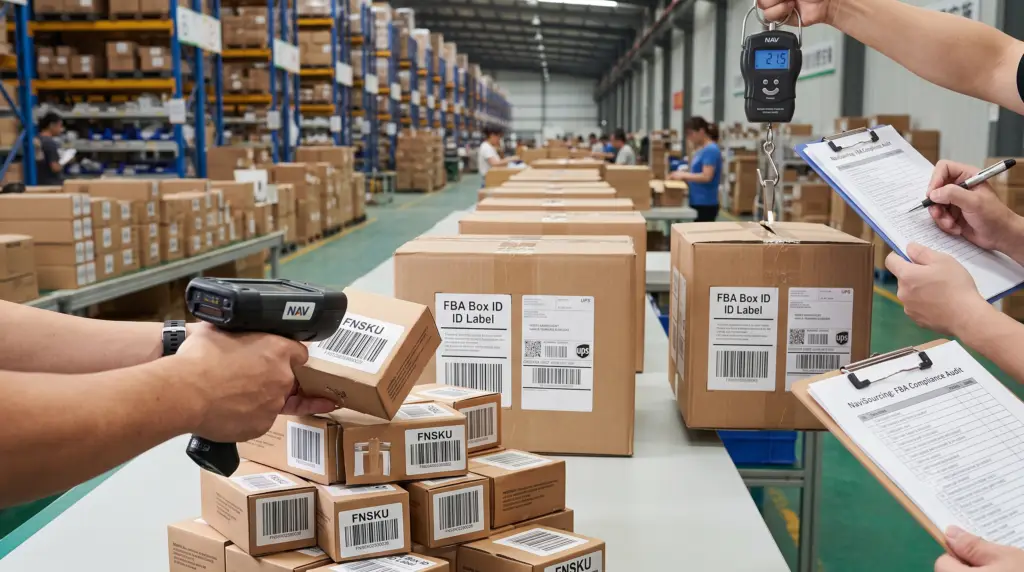
How we handle this on-site: At NaviSourcing, our inspectors do not just look at the labels. We use actual handheld FBA-compliant barcode scanners on the factory floor to test-scan random samples of your FNSKUs under real-world warehouse lighting. If a label fails to register, we halt the packing process and require the supplier to reprint the batch.
3. Carton-Level Audits: Master Box IDs and Shipping Marks
Once individual units are correct, you must audit the master cartons. If Amazon’s receiving dock cannot scan your outer box, the entire carton goes into a “holding zone” (the black hole of lost inventory), and you will be hit with an inbound defect fee.
The “Box Seam” Cut
Factories love to tape the master cartons shut and then paste the FBA Box ID and carrier labels (like UPS or FedEx) directly over the middle tape seam. When the Amazon warehouse receiver uses a box cutter to slice the carton open, they slice straight through your barcode.
- The Standard: All outer labels must be placed on the side panels of the carton, at least 1.25 inches away from any seam or edge. They must be flat and unwrinkled.
Recycled Cartons and Ghost Barcodes
To save money, factories often reuse old corrugated boxes. If an old UPS tracking barcode or a hazardous material symbol from a previous shipment is still visible on the box, Amazon’s automated sorting machines will flag it as a conflict, leading to misrouted or lost cargo.
To prevent this, you must demand that the factory uses brand-new packaging materials. We highly recommend incorporating these strict packaging rules into your prep guidelines and scheduling independent, FBA-compliant shipment-ready packaging checks before the container is sealed.
4. Box Content & Weight Compliance: Digital vs. Physical
Amazon’s automated receiving system compares the physical weight of the incoming carton against the data you submitted in your “Send to Amazon” shipping plan. Any discrepancy flags your account.
The Rusted Scale Problem
Most manufacturing facilities in China use heavy-duty platform scales that are rarely calibrated. If your factory records a master carton of drinkware at 48 lbs, but Amazon’s calibrated digital scale reads it as 50.2 lbs, you have committed an FBA violation.
- The Rule: Standard FBA cartons must not exceed 50 lbs (22.6 kg) unless they contain a single oversized item. If a box is over 50 lbs, it must have high-visibility “Team Lift” or “Heavy” warning labels printed on all four sides.
- The Consequence: Overweight violations trigger immediate “Inbound Performance Alerts.” If you receive multiple alerts, Amazon will suspend your shipment creation privileges, forcing you to submit a formal Plan of Action (POA) while your inventory sits stranded.
Piece-Count Discrepancies
If your digital packing list says Master Carton #1 contains 24 units of SKU-A, it cannot contain 23 units of SKU-A and 1 unit of SKU-B. If Amazon finds a mismatch, they will stop processing the shipment and charge you an Inbound Defect Fee or manual processing surcharge.
During a pre-shipment check, always instruct your on-site inspector to verify carton weight on calibrated digital scales and document each physical reading with a high-resolution photo evidence pack before the cargo leaves the facility.
5. Setting Up a “Fail-Safe” Check in China
Do not expect your supplier to self-audit. To ensure your shipment arrives at FBA without a single warning, you need to establish a clear, non-negotiable inspection pipeline before releasing your final payment.
FBA-Ready Ground Validation Pipeline
Before you finalize your next manufacturing run, take the time to review our guide on how to draft a Quality Agreement with Chinese suppliers to secure your FBA specs. Once your cargo is labeled and ready, protect your transit timeline by reviewing our comprehensive guide on FBA ocean freight and logistics from China.
Frequently Asked Questions (FAQs)
Q1: Can I print the FNSKU directly onto my custom product box instead of using stickers?
Yes, this is highly recommended. Printing the barcode directly onto your retail box or cardboard sleeve eliminates the risk of stickers peeling off or bubbling. However, make sure your packaging designer leaves a solid white background behind the barcode lines (no textures or colors) and maintains a 0.25-inch “quiet zone” (blank margin) around the entire barcode so scanners can read it.
Q2: What happens if my supplier uses cheap inkjet printing for FBA labels?
Inkjet prints run and smudge the moment they are exposed to moisture. If your shipping container experiences humidity during ocean transit, the ink will bleed, making the barcodes unreadable. Always insist that your supplier uses a thermal transfer printer with resin ribbons.
Q3: What is the exact weight limit for FBA master cartons shipping from China?
For standard shipments, the limit is 50 lbs (22.6 kg) per carton. If your carton weighs even 50.1 lbs, it is considered overweight and must have “Team Lift” labels on all sides. For shipments bound for Amazon UK or Europe, the limit is lower—typically 23 kg (50.7 lbs), but individual partner carriers may enforce a strict 15 kg (33 lbs) limit unless marked otherwise. Always verify your specific destination marketplace rules before packing.
Q4: If the factory makes a labeling mistake, how do I recover the cost?
If you have a signed Quality Agreement or a detailed Proforma Invoice (PI) that clearly outlines FBA compliance specifications, you have the right to withhold the cost of correction from the final 70% balance. If you have already paid the balance, your only real option is to negotiate a credit or discount on your next production run. This is why on-site pre-shipment inspections are so vital.
Q5: Is it safe to let my freight forwarder handle FBA labeling instead of the factory?
Yes, but only if they operate a secure, professional prep setup. If you want to bypass the factory’s poor labeling or if they refuse to print thermal labels, it is safer to route your goods through our dedicated warehouse value-added services in China. This ensures your products are properly repackaged and relabeled under strict oversight before they are handed over to the shipping line.
Stop Shipping Blind. Let NaviSourcing Be Your FBA Eyes in China.
In global trade, hope is not a business strategy. A single low-resolution print or an uncalibrated scale at your factory can turn a highly anticipated product launch into an expensive logistics mess. At NaviSourcing, we protect your bottom line by auditing your suppliers, verifying your packaging, test-scanning your FNSKUs, and weighing your cartons before you wire your final payment. We handle the risks in China so you can focus on scaling your brand.
Contact NaviSourcing Support Team