Partner with Us for Quality Solutions
Quality & Risk Control
Reduce defects and shipment surprises with a documented QC workflow—from pre-production checks to evidence packs and corrective actions. Built for multi-SKU sourcing, where small mistakes in packing, labeling, or consistency can break the whole shipment.
Quality & Risk Control
Defect Grading (Critical / Major / Minor)
Critical
safety or compliance risk — must not ship
Major
impacts usability/sales — rework or replace required
Minor
small cosmetic issues — acceptable only within agreed limits
QC SOP Corrective Actions (CAPA)
4 steps:
Identify and isolate defects (with evidence)
Decide action: rework / replace / discount / scrap
Re-check after action (verification inspection)
Confirm release or hold shipment
Identify and isolate defects (with evidence)
Decide action: rework / replace / discount / scrap
Re-check after action (verification inspection)
Confirm release or hold shipment
3PL/FBA Readiness Checks
Most shipment rejections come from labeling and carton mismatch—not product defects.
- Barcode scannability and placement
- Carton marks vs packing list consistency
- Polybag/warning labels when needed
- Set/bundle labeling rules (“sold as set”)
- Carton integrity and internal protection
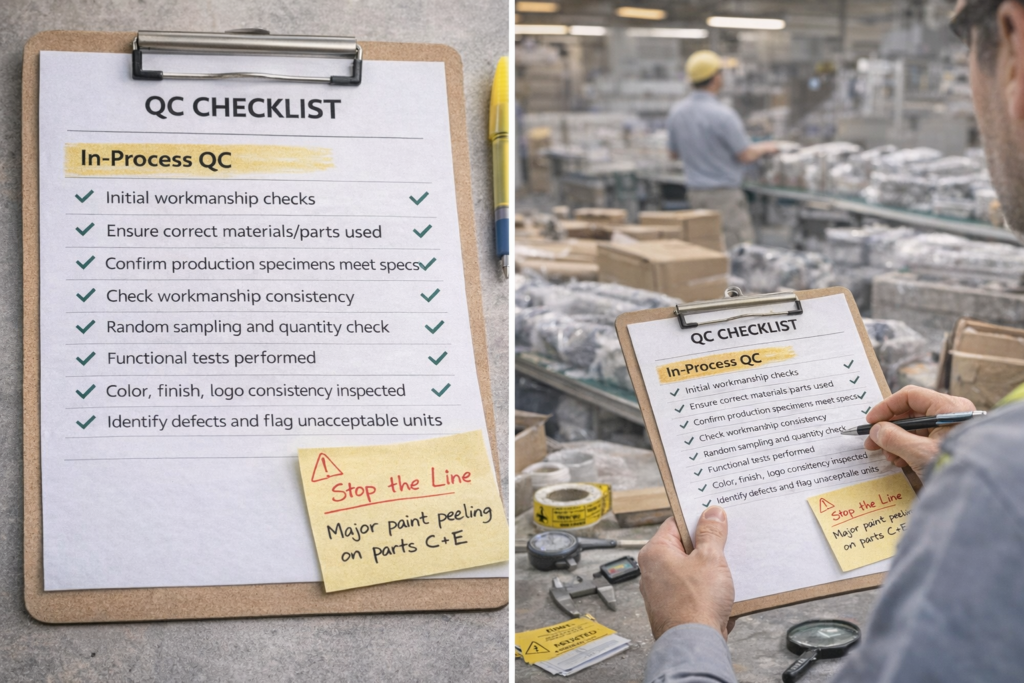
Get the QC Checklist (PDF)
Download a reusable checklist covering inspection stages, defect grading, evidence pack, and corrective actions.
Quality Control FAQs
Common Questions about Our Quality Control Process
What should be included in a QC inspection report?
A strong QC report should include: order and lot details, sampling plan summary (if AQL is used), quantity verification, test results (function/appearance), packaging and labeling checks, defect photos/videos, a defect list grouped by severity (Critical/Major/Minor), and a clear pass/fail decision with corrective actions and next steps.
Do you use AQL sampling for inspections?
Yes. AQL sampling is commonly used for pre-shipment inspections when full inspection is not required. We align the sampling approach with your risk level and product type, and we always define defect grading (Critical/Major/Minor) and acceptance criteria in writing before inspection—so the decision is clear.
When should I choose In-Process QC (DUPRO) vs Pre-Shipment Inspection (PSI)?
Use In-Process QC (DUPRO) when you want to catch problems early—especially for new suppliers, first orders, tight deadlines, or multi-SKU production. Use Pre-Shipment Inspection (PSI) as the final gate before dispatch. The most reliable approach is DUPRO + PSI: early detection reduces costly rework, and the final inspection confirms shipment readiness.
How do you define Critical, Major, and Minor defects?
We use a simple, buyer-friendly grading:
Critical: safety, compliance, or non-usable issues — must not ship
Major: impacts usability/sales (function failure, visible damage) — rework/replace required
Minor: small cosmetic issues — acceptable only within agreed limits
Defect grading and thresholds should be confirmed before production to avoid disputes later.
What happens if defects are found during inspection?
We follow a corrective-action loop:
isolate the defective units and document evidence (photos/videos)
classify defects (Critical/Major/Minor) and confirm actions
execute corrective actions (rework/replace/discount/scrap)
re-check (verification inspection) before approving shipment
This prevents “ship now, fix later” outcomes that cause returns and chargebacks.
Can you handle QC for multi-SKU or multi-supplier orders?
Yes. For multi-SKU orders, the biggest risks are mixed cartons, missing units, and inconsistent packaging/labels. We focus on SKU-level counting, carton mark vs packing list consistency, and evidence capture—so you can trace issues by SKU and supplier, not just by “the shipment.”
Can you support 3PL/FBA-ready packaging and labeling checks?
Yes. Many shipment rejections happen due to labeling and carton issues rather than product defects. We check barcode scannability and placement, carton marks vs packing list, polybag/warning labels when required, set/bundle labeling rules (“sold as set”), and carton integrity for transit—so shipments are warehouse-ready.
Can we sign an NDA and keep supplier/product info confidential?
Yes—NDA is available upon request. We can also limit what appears in shared materials and provide “evidence packs” with sensitive details blurred if needed, while still preserving the proof required for decision-making and dispute resolution.