In-Process QC vs Pre-Shipment Inspection
In-Process QC and Pre-Shipment Inspection are not interchangeable. In-Process QC helps buyers catch production drift early enough to correct it while the order is still in progress. Pre-Shipment Inspection helps verify what is actually ready before goods leave, but by that stage, some problems may already be expensive, politically difficult, or operationally slow to fix. The real difference is not only when the inspection happens. The real difference is whether problems are found while they can still be corrected, or only after the order is already close to shipment.
The short answer
In-Process QC is better for catching production drift early enough to intervene. Pre-Shipment Inspection is better for confirming what is actually ready before goods leave. If you only check at the end, you may still discover real problems, but some of them may already be too late to fix cleanly.
What buyers are really asking
- Which inspection catches problems earlier?
- Is final inspection alone enough?
- When is mid-production checking worth the cost?
- Which stage is better for product issues, and which is better for shipment-ready issues?
What is the real difference between In-Process QC and Pre-Shipment Inspection
Buyers often compare these two checkpoints as if they are simply two versions of the same inspection. In reality, they serve different decision purposes. In-Process QC is mainly about interception. It looks at the order while production is still moving, so the buyer can see whether the order is drifting away from the approved version early enough to do something meaningful about it. Pre-Shipment Inspection is mainly about verification. It looks at what is already finished, packed, or close to shipment, and helps confirm what the buyer is about to receive.
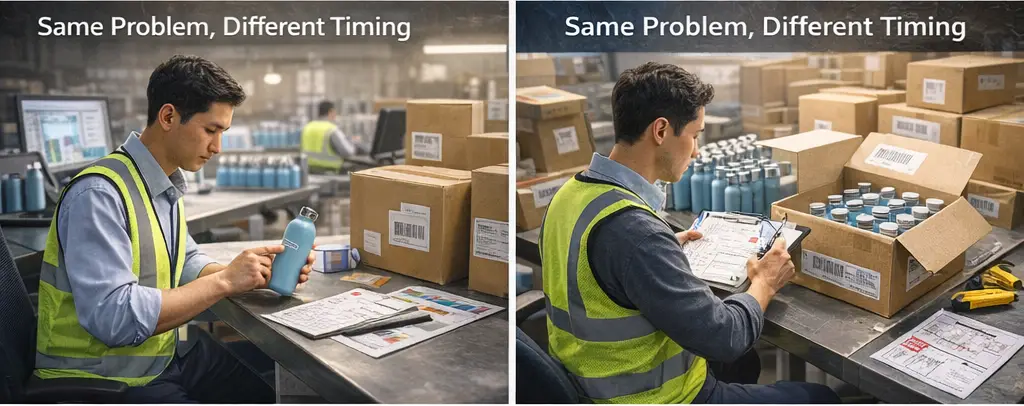
That difference matters because timing changes the value of the finding. The same issue can have very different consequences depending on when it is discovered. A logo placement problem found during production may still allow correction on the remaining quantity. The same problem found at final inspection may mean large-scale rework, relabeling, shipment delay, selective sorting, or a commercial compromise instead of a clean fix.
In practical sourcing work, these checkpoints usually sit inside a broader quality risk control process. The inspection itself is only part of the value. The bigger question is whether the timing of that inspection still leaves room to correct the problem without destabilizing the whole order.
What each inspection stage is actually good at catching
What In-Process QC is better at catching
In-Process QC is usually more valuable for spotting production drift, repeatability issues, unstable workmanship, and execution inconsistencies while the order is still being made. This is especially important when one approved sample must be reproduced across multiple operators, material batches, shifts, or SKUs.
- Dimension drift or tolerance instability
- Material substitution or finish inconsistency
- Print, logo, stitching, or assembly variation
- Early mismatch across SKUs or variants
- Process execution that looks acceptable on a few pieces but unstable in quantity
- Problems that are still correctable if seen before the whole batch is completed
How this is usually controlled in real projects
In real projects, the value of In-Process QC comes less from “seeing defects” and more from catching the right kind of drift while correction is still practical. We usually treat this stage as an interception point: if dimensions, workmanship, print quality, component usage, or multi-SKU consistency start moving in the wrong direction, the goal is to raise that signal early enough for the supplier to adjust process execution rather than let the order continue until the deviation becomes expensive.
What Pre-Shipment Inspection is better at confirming
Pre-Shipment Inspection is more useful for confirming the final ready state of the order. By that point, the buyer wants to know what actually exists, how the finished goods are packed, whether the quantity is complete enough, and whether the order is ready to move without creating downstream delivery failure.
- Finished quantity and sampling status
- Final workmanship condition of the completed goods
- Packaging status and presentation condition
- Barcode position, insert version, carton marks, and shipment-facing readiness
- What the buyer is actually about to receive if the shipment goes ahead
- Whether late-stage problems are still small enough to accept, sort, or correct
Why Pre-Shipment Inspection alone is not always enough
One of the most common buyer assumptions is that final inspection should be enough, because it happens closest to shipment and therefore feels more decisive. The problem is not that final inspection has no value. The problem is that it often confirms the result after too many production decisions have already become difficult to reverse. If the issue is minor and localized, Pre-Shipment Inspection may still work well as a final control gate. But if the issue is structural, repeated across quantity, or linked to execution earlier in production, finding it late can turn a manageable problem into a painful one.
This is why buyers should not confuse “we checked before shipment” with “the order was controlled early enough.” These are not the same. A final check can still be professionally done and still be too late for a clean correction path.
What final inspection can still do well
Confirm shipment-ready condition, identify late-stage visible issues, verify carton-level details, and help buyers decide whether the order should ship, hold, sort, or be partially corrected.
What final inspection often cannot fix cleanly
Batch-wide production drift, repeated workmanship inconsistency, large-volume packaging error, or multi-SKU execution problems that should have been intercepted earlier.
Problems that become expensive if found too late
- A wrong logo method already applied across a large batch
- Dimension instability affecting multiple cartons or size runs
- Repeated stitching, print, or assembly inconsistency across SKUs
- Packaging configuration completed incorrectly on most of the order
- Insert cards, label versions, or carton marks applied at scale using the wrong file set
- A late-stage finding that now creates delay, rework cost, supplier resistance, or shipment compromise
How we usually look at this in real projects
When the order contains production complexity, we usually do not treat final inspection as the first meaningful control point. If a problem is likely to become expensive once the batch is nearly complete, the smarter move is usually to create an earlier interception opportunity. Final inspection still matters, but it works better as a verification gate than as the only protection against avoidable production drift.
Not all problems belong to the same inspection stage
A major reason buyers choose the wrong checkpoint is that they treat every risk as if it should be caught by the same type of inspection. In reality, the inspection stage should match the kind of risk.
Risks better suited to In-Process QC
Anything related to repeatability, process drift, operator execution, material usage, or consistency across quantity is usually better caught during production rather than at the end.
Risks better suited to Pre-Shipment Inspection
Anything tied to final quantity, shipment presentation, packaging completion, barcode position, insert version, carton marks, and final shipment-readiness is usually more meaningful at the finished stage.
Risks that need both stages to be managed well
Some orders cannot be protected well by a single checkpoint. Multi-SKU programs, complex private label orders, packaging-heavy retail programs, bundling projects, and orders with meaningful delivery deadlines often benefit from earlier interception and later verification. The first stage reduces drift. The second stage confirms what actually survived into finished goods.
When buyers should prioritize In-Process QC, Pre-Shipment Inspection, or both
When In-Process QC becomes more valuable
- The product is hard to reproduce consistently
- The order has multiple SKUs, variants, or pack combinations
- The project includes new materials, new finish standards, or complex workmanship
- A late-stage failure would create expensive rework or a missed launch window
- The buyer wants a real chance to correct drift before the order is complete
When Pre-Shipment Inspection may still be sufficient
- The order is simple and highly repeatable
- The supplier has strong repeat history on the same item
- Packaging and final shipment details are more critical than production drift
- The buyer accepts that late-stage findings may lead to ship / hold / compromise decisions rather than elegant correction
- The order risk is low enough that final verification is commercially acceptable
When using both makes the most sense
If the order has both production complexity and delivery complexity, then using both stages often makes the logic stronger. The earlier checkpoint is there to reduce drift while correction is still realistic. The later checkpoint is there to confirm what is actually ready to leave. This is often the safer path in OEM programs, seasonal launches, packaging-heavy projects, retail-ready orders, or multi-SKU orders where consistency and final presentation both matter.
How this is usually controlled in real projects
Buyers often ask which checkpoint is “better,” but the stronger question is which checkpoint gives the project the right kind of protection at the right time. In real sourcing work, we usually start by asking where the order is most likely to fail: during production execution, during packaging and final preparation, or in both places. That risk pattern usually tells us whether earlier interception, later verification, or both will create the most useful control.
When the real risk is production drift
If the main concern is consistency, repeatability, operator execution, material use, or SKU-to-SKU variation, we usually try to build in an earlier interception point rather than waiting for final inspection. That gives the supplier a chance to adjust process behavior while the order is still moving, instead of forcing the whole discussion into a late-stage pass / fail argument.
When the real risk is shipment-facing execution
If the project is especially sensitive to packaging, labels, insert cards, barcode position, carton marks, bundle logic, or final pack-out condition, then the later verification stage becomes more important. In those cases, the buyer is not only checking the product. The buyer is checking whether the finished order is commercially usable and ready to move correctly.
How we usually handle packaging-heavy or shipment-sensitive projects
For projects where shipment-facing details carry real risk, we usually try to avoid treating the final stage as a simple visual check. Barcode placement, insert versions, carton marks, relabeling logic, and pack-out condition often need clearer confirmation and cleaner evidence because these details can still delay shipment even when the core product looks acceptable. Where necessary, we also align those final checks with the actual warehouse value-added workflow, because some failures appear only when the order moves into packing, relabeling, insert handling, or shipment preparation.
Why visual evidence and follow-up matter after both checkpoints
A passed inspection is only as useful as the evidence behind it and the follow-up that happens after it. If a problem is found during production, the next question is whether the correction was actually implemented. If a problem is found before shipment, the next question is whether the final status was rechecked clearly enough. That is why visual evidence matters at both stages. Inspection without traceable follow-up can easily become a report that describes a problem but does not truly close it.
In our experience, both mid-production findings and late-stage corrections become much easier to manage when they are supported by structured visual confirmation. That is where a documented photo evidence pack becomes useful, because it helps buyers review what was found, what was corrected, and what the order actually looked like at each key checkpoint.
A practical checklist before choosing In-Process QC or Pre-Shipment Inspection
- Is this order easy to reproduce, or does it have real execution complexity?
- If a problem appears, can it still be corrected in time?
- Does the order contain multiple SKUs, variants, or pack combinations?
- Are packaging, insert, barcode, or carton details critical to final delivery?
- Would a late-stage failure cause shipment delay, rework cost, or retailer rejection?
- Is the buyer trying to intercept drift, verify final status, or both?
- If an issue is found during production, is there a clear correction follow-up path?
- Is visual evidence being captured for later review and decision-making?
FAQ
Is In-Process QC better than Pre-Shipment Inspection?
Not in a simple universal way. In-Process QC is better for catching production drift early enough to intervene. Pre-Shipment Inspection is better for confirming what is actually ready before goods leave. The better choice depends on what kind of risk the buyer is trying to control.
Is Pre-Shipment Inspection alone enough for most orders?
It may be enough for simple, repeatable, lower-risk orders. But for more complex products, multi-SKU programs, packaging-sensitive projects, or orders where late-stage failure is expensive, relying only on final inspection can leave too much risk until too late.
What kinds of issues are most useful to catch during production?
Production drift, unstable workmanship, material inconsistency, dimension variation, print or assembly execution problems, and multi-SKU inconsistency are often more useful to catch during production while correction is still realistic.
What kinds of issues are most meaningful to confirm before shipment?
Final quantity, shipment-ready packaging, barcode position, insert versions, carton marks, pack-out condition, and overall final presentation are often most meaningful at the finished stage.
If a problem is found during In-Process QC, what matters next?
The key issue is not only finding the problem, but whether correction happens and whether the corrected status is later confirmed. That is why follow-up, visual proof, and a clear correction path matter so much after mid-production findings.
Final takeaway
The difference between In-Process QC and Pre-Shipment Inspection is not just where they sit on a timeline. The real difference is whether the order is being checked while meaningful correction is still possible, or only after the finished result is already close to leaving. Buyers who understand that difference usually make better inspection decisions, because they stop treating every checkpoint as interchangeable.
In practice, the smarter choice is usually the one that matches the risk pattern of the order: earlier interception for production drift, later verification for shipment-readiness, and stronger evidence and follow-up around both. That logic usually becomes clearer when the order is reviewed through a defined quality risk control approach, supported by a documented photo evidence pack, and aligned where needed with final warehouse and shipment-facing handling details.
