
Approved Sample, Wrong Bulk Order: Why It Happens
An approved sample does not automatically guarantee a correct bulk order. In most sourcing projects, bulk order problems happen because the approved sample was never fully translated into a clear production standard, packaging standard, labeling standard, and execution control process. Buyers often approve what they see in one sample, while factories later produce based on internal interpretation, incomplete tolerances, shifting files, packaging assumptions, or inconsistent bulk execution.
The short answer
A sample can be correct, but the bulk order can still go wrong if the sample approval did not fully lock what the factory must repeat, how much variation is acceptable, what packaging or labeling version applies, and what controls will catch drift during production.
What buyers usually want to know
- Why did bulk production not match the sample?
- Was it a factory issue or an approval issue?
- Which mismatches are most common?
- What could have been controlled earlier?
Why an approved sample does not always protect the bulk order
Many buyers understandably assume that sample approval should protect the project. After all, the factory made a sample, the buyer reviewed it, and both sides agreed to move forward. The problem is that a sample is only one physical output. Bulk production is a repeatable system. If the approved sample is not backed by clearly defined specifications, acceptable tolerances, packaging instructions, file versions, and execution checkpoints, then the factory is not really following a locked standard. It is following a remembered or interpreted version of the sample.
This is why buyers sometimes hear, “We followed the sample,” while still feeling that the finished order is wrong. In many cases, both sides are reacting to different reference points. The buyer is comparing the bulk order to the approved sample as a whole. The supplier is comparing the bulk order to its own production understanding, which may not fully include all the details the buyer thought were already settled.
This is exactly why sample approval should sit inside a broader quality risk control process. The sample alone is not enough unless it is connected to production standards, checkpoints, and correction logic.
Where the gap usually happens between sample approval and mass production
The gap usually does not appear in one dramatic moment. It appears in a series of small, practical disconnects between what was approved, what was documented, what was handed to production, and what was actually repeatable at scale.
1. The sample was approved, but the standard was not
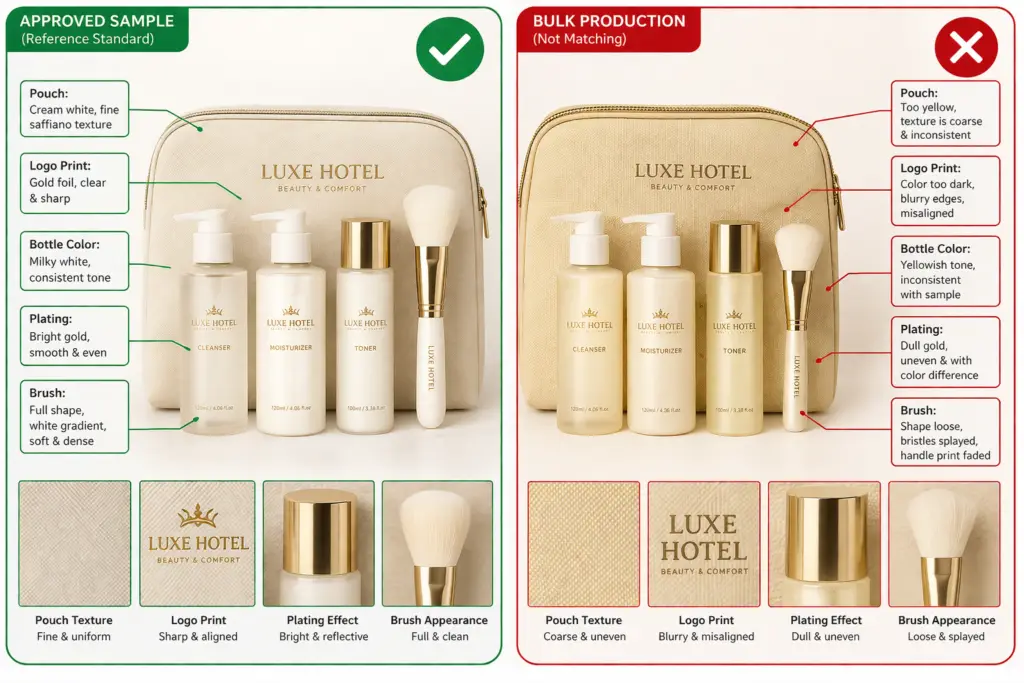
Buyers often approve a sample visually, but leave too much unstated. The physical item may look acceptable, yet key standards remain vague. This often happens with dimensions, material feel, finish level, shade consistency, logo placement, or acceptable variation. Once production begins, what the buyer thought was “obviously part of the approved sample” may turn out to be something the factory treated as flexible.
- No clear tolerance for size, weight, thickness, or finish
- No defined acceptable variation for color or print alignment
- Logo appearance approved, but logo method not locked
- Function approved in one sample, but consistency never validated in quantity
- The supplier treats “close enough” differently from the buyer
2. The product was approved, but the delivery version was not
In many projects, what buyers approve is the product in hand, while what actually gets delivered includes much more: packaging, inserts, barcode stickers, carton labels, inner pack quantities, and channel-facing presentation. The product may be correct, but the order can still be commercially wrong.
3. The sample could be made well once, but not repeated consistently
One of the biggest misunderstandings in sourcing is assuming that if a supplier can make one good sample, it can automatically reproduce that result across a full production run. Sample making is usually more controlled, slower, and more closely watched. Bulk production is different. More workers, more material batches, more machine runs, tighter deadlines, and more packaging steps all create more room for variation.
Sample stage
Lower quantity, more attention, more manual adjustments, more time spent on appearance and detail.
Bulk stage
Higher volume, multiple operators, broader material variation, faster throughput, and greater execution pressure.
That difference matters for print stability, stitching consistency, finish quality, fit, assembly details, color control, component sourcing, and packaging accuracy. In other words, a sample can prove possibility, but it does not automatically prove repeatability.
4. Internal supplier handoff changes the approved version
Another common problem is internal interpretation. The person who handled the sample stage may not be the same person managing the production line, packaging team, or warehouse execution. Once the project moves from sales or development into production, the approved version can get simplified, summarized, or partially lost during handoff.
Buyers often underestimate this risk because they assume the supplier functions as one unified understanding. In practice, projects often pass through multiple teams. If the approval record is weak, each handoff creates opportunity for drift.
5. Packaging, labels, and shipment-facing details change later than product decisions
Buyers frequently focus on the product sample first and postpone packaging, labels, insert cards, barcode files, carton marks, or assortment logic until later. That delay creates one of the most dangerous mismatch patterns: the product itself may stay close to sample, but the order becomes wrong at the delivery stage.
This happens often in private label, Amazon FBA, retail-ready, and multi-SKU programs. The order may be technically usable, but commercially wrong because the shipment is not aligned to the selling channel or buyer requirements.
If your project includes relabeling, insert handling, repacking, bundle building, or carton-level corrections, the approved version should also be checked against the actual warehouse value-added workflow, not only against the product sample itself.
The most common reasons bulk orders drift away from approved samples
Unclear tolerances
The sample looked right, but the acceptable range was never defined. This is one of the most frequent causes of disputes because both sides believe they are being reasonable.
Material or finish instability
A material batch, coating, stitching result, print sharpness, or surface texture may not behave the same in larger runs as it did in the sample.
Packaging approved too late
Buyers approve the item but leave packaging or label content unresolved. Later, the project fails not because the product is wrong, but because the finished order is not shipment-ready.
File version confusion
Revised artwork, barcode files, insert content, or carton markings may exist in multiple versions. If no one controls the final reference set, the wrong one may enter production.
Multi-SKU inconsistency
One SKU may match the approved sample while other SKUs drift in size, color, print, packaging, or assortment rules. Buyers often discover this too late because they mentally treat the project as one product family.
No in-process interception
When no one checks the project between sample approval and final shipment, small deviations become large batch-level problems. By the time the buyer sees them, correction is slower, more expensive, and more politically difficult inside the supplier relationship.
A practical buyer checklist to reduce sample-to-bulk mismatch
- Tie the approved sample to written specs, not just verbal agreement
- Define tolerances for measurable and visual variation
- Lock packaging, barcode, insert, and carton rules earlier
- Confirm the exact artwork and file version being used
- Review all SKUs individually in multi-SKU projects
- Plan an in-process check instead of waiting until shipment
- Preserve photo and video references of the approved version
- Make sure the supplier handoff is based on the same final reference set
One of the most useful protections here is a structured visual record. A sample approval becomes much stronger when the project also includes traceable photos, packaging references, label confirmation, and execution details captured through a documented photo evidence pack.
What buyers often underestimate
Most sample-to-bulk problems are not caused by one dramatic failure. They are caused by a chain of underestimated details. Buyers often underestimate how much execution depends on tolerance definition, internal supplier handoff, packaging timing, file control, and process checks after approval. That is why the problem is often not visible at sample stage, but becomes obvious during production, packing, or pre-shipment review.
In other words, the sample may not have been wrong. The control system around the sample may simply have been too weak.
FAQ
If the sample was approved, does that mean the supplier is fully responsible for bulk mismatches?
Not always in a simple way. Suppliers are responsible for execution, but many mismatches also come from weak approval standards, vague tolerances, incomplete packaging confirmation, or poorly controlled file versions. The real issue is often shared process weakness rather than one isolated mistake.
Why can a factory make one correct sample but still fail in bulk?
Because sample making proves possibility, not automatic repeatability. Bulk production involves more operators, more material batches, more time pressure, and more packaging complexity. If repeatability was not controlled, drift becomes much more likely.
What kind of bulk mismatches are most common?
Common mismatches include color drift, print or logo inconsistency, finish variation, inaccurate dimensions, unstable fit, wrong insert version, incorrect barcode placement, carton marking errors, and packaging that does not match the approved delivery format.
Is packaging really as important as the product itself?
Yes. In many projects, the product may be acceptable while the shipment still fails because labels, inserts, barcode files, pack quantities, or carton details were not controlled. Buyers often discover too late that the delivery version matters as much as the item itself.
What should buyers do after approving a sample, before waiting for final shipment?
Buyers should confirm the final reference set, define tolerances, align packaging and shipment-facing details, preserve visual evidence, and plan at least one meaningful production-stage review. That is where the approved sample becomes a controlled execution standard rather than a fragile expectation.
Final takeaway
The real problem is usually not that the sample was approved. The real problem is that the approved sample was never fully turned into a controlled bulk execution standard. That is why buyers who want better bulk consistency should think beyond sample approval itself and focus on what happens after approval: documentation, tolerances, handoff, packaging alignment, process checks, and traceable evidence.
In practical sourcing work, this usually means treating the approved sample as the beginning of control, not the end of it, supported by a clearer quality risk control flow, stronger visual proof through a documented photo evidence pack, and better alignment with any later warehouse handling and packaging execution.
